 Pompeii Private Tour
What to See in Pompeii: The 20 Stops That Matter
What to see in Pompeii is the question the site's size punishes: about 19 of its 44 excavated hectares are walkable, the stones carry almost no information panels, and a first-time visitor with three hours can spend them badly without ever knowing it. This is the shortlist that keeps a visit honest - the twenty stops that earn their place, ordered roughly as you meet them from Porta Marina, each with what it is and why it survives the cut.
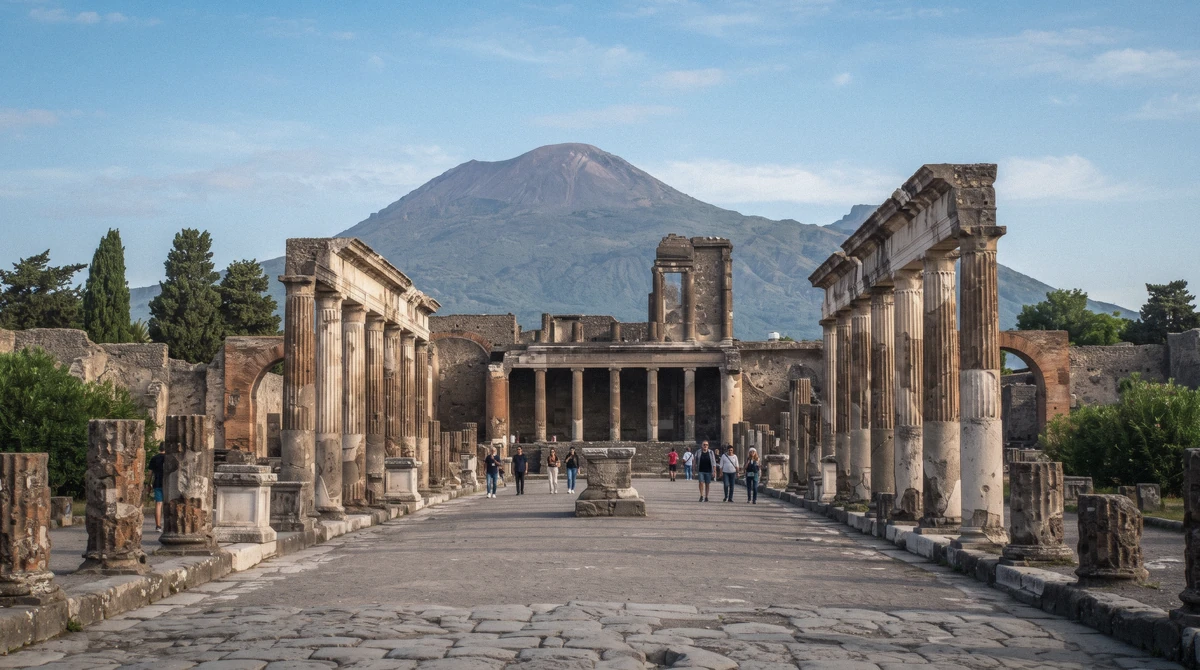
The Forum and the volcano that ended it in one frame - the sight every route builds toward, and the one no photo quite carries.
Quick answer The can't-miss core, the two halves of the site, and how the twenty stops fit a two- or three-hour slot
The unmissable core of Pompeii: the Forum with Vesuvius behind it, the Basilica, the House of the Faun (the city's grandest house), the Stabian Baths, the Large Theatre, and the thermopolia - the Roman fast-food counters. Two hours covers the western core; the third hour buys the east - the amphitheatre, oldest surviving Roman one, and the Garden of the Fugitives casts. A guide earns their fee by sequencing these twenty stops - the site has almost no panels, and half the buildings' meaning is invisible without one.
Key takeaways
- Two-hour slot? Run the western core - Forum, Faun, baths, theatres - and save the east for a second ticket (3-day ticket is EUR 30)
- The Askos deep route is the only comparison itinerary naming all ten of its stops including the amphitheatre
- Opening houses rotate - check the park's open-buildings list the week you go; frescoed houses close for rest and study without notice
The Twenty Stops, In Walking Order
Ordered as a Porta Marina entry meets them, west to east; the walking order is the guide's first skill and the self-guided visitor's first trap.
| # | Stop | What it is | Why it matters |
|---|---|---|---|
| 1 | Porta Marina | The sea gate | Entry theatre: the city's main door, built to impress |
| 2 | Temple of Apollo | Oldest sanctuary | Greek-era city under the Roman one |
| 3 | The Forum | Civic square | The heart - politics, markets, Vesuvius in frame |
| 4 | Basilica | Law courts, 2nd c. BC | Rome's civic architecture at full ambition |
| 5 | Temple of Jupiter | Capitolium | The triad temple that anchored the Forum's north |
| 6 | Forum Baths | Public bathing | Hypocaust floors and the bath routine explained |
| 7 | House of the Faun | The grandest domus | Dancing Faun, Alexander Mosaic's original floor |
| 8 | House of Menander | Merchant mansion | Frescoes and the silver-hoard story |
| 9 | House of the Vettii | Freedmen's show house | Reopened after years of restoration; Priapus at the door |
| 10 | Thermopolium of Aselina | Roman fast food | Counter pots where the poor ate out |
| 11 | Bakery of Modestus | The bread line | Carbonized loaves found in its oven |
| 12 | Stabian Baths | The oldest baths | The full bathing sequence, Women's wing separate |
| 13 | Via dell'Abbondanza | The main street | Cart ruts, stepping stones, electoral graffiti |
| 14 | Large Theatre | 5,000-seat theatre | Acoustics that still work; Greek-style hillside design |
| 15 | Odeon (Small Theatre) | Roofed music hall | Two thousand seats, better acoustics, less crowd |
| 16 | Quadriporticus | Gladiators' barracks | The theatre's colonnaded yard, later their HQ |
| 17 | Garden of the Fugitives | The plaster casts | Thirteen victims of the second surge - the eruption, felt |
| 18 | House of the Cryptoporticus | Cool basement gallery | The elite's air conditioning, and the frescoed vaults |
| 19 | Temple of Isis | The Egyptian cult | Imported religion, and the first building re-excavated |
| 20 | Amphitheatre | Oldest surviving Roman one | 20,000 seats and the 59 AD riot painted on a wall |
How the twenty fit your slot
A two-hour visit reaches stops 1-12 comfortably with a guide (1-9 at a self-guided pace). The three-hour formats add the theatre district (14-16) and, on the fullest route, push east to 17-20. Nobody honest covers all twenty in one slot - the site is too big and the houses close; a 3-day ticket (EUR 30) is the park's own answer to that arithmetic.
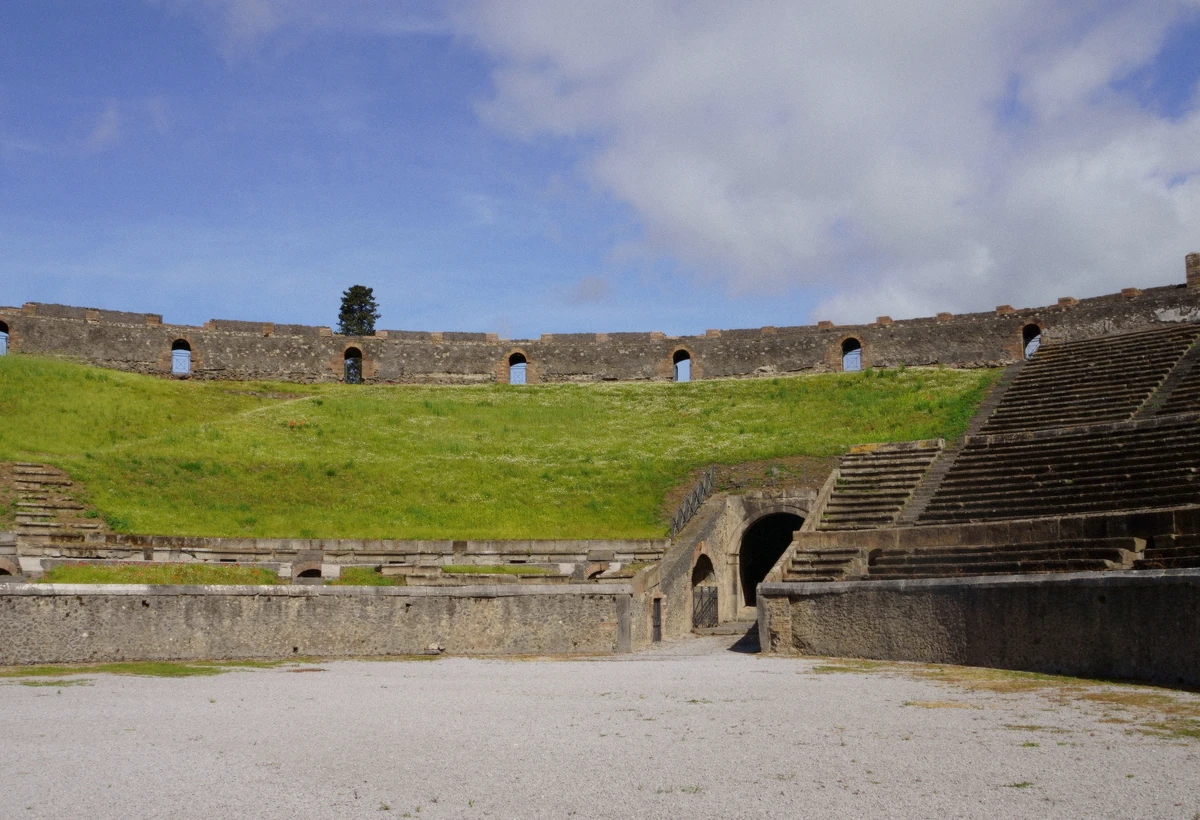
The arena inside: built in 70 BC, twenty thousand seats, and the walk’s eastern payoff. Photo: Commonists / Wikimedia Commons / CC BY-SA 4.0.
The Western Core: If You Have Two Hours
The unmissable density sits in the civic west, and any private route runs it: the Forum with its temples and the volcano framed behind the columns; the Basilica, whose clipped brick arcades read as modern until you count the centuries; the House of the Faun, where the Alexander Mosaic's original floor sits under a skylight and the Dancing Faun's statue names the house; and the Stabian Baths, where the bath routine - cold to warm to hot, floor hollowed for furnace air - becomes physically legible. Two hours with a guide covers this core plus a thermopolium and a stretch of Via dell'Abbondanza; without one, it covers the Forum and a lot of confident walking.
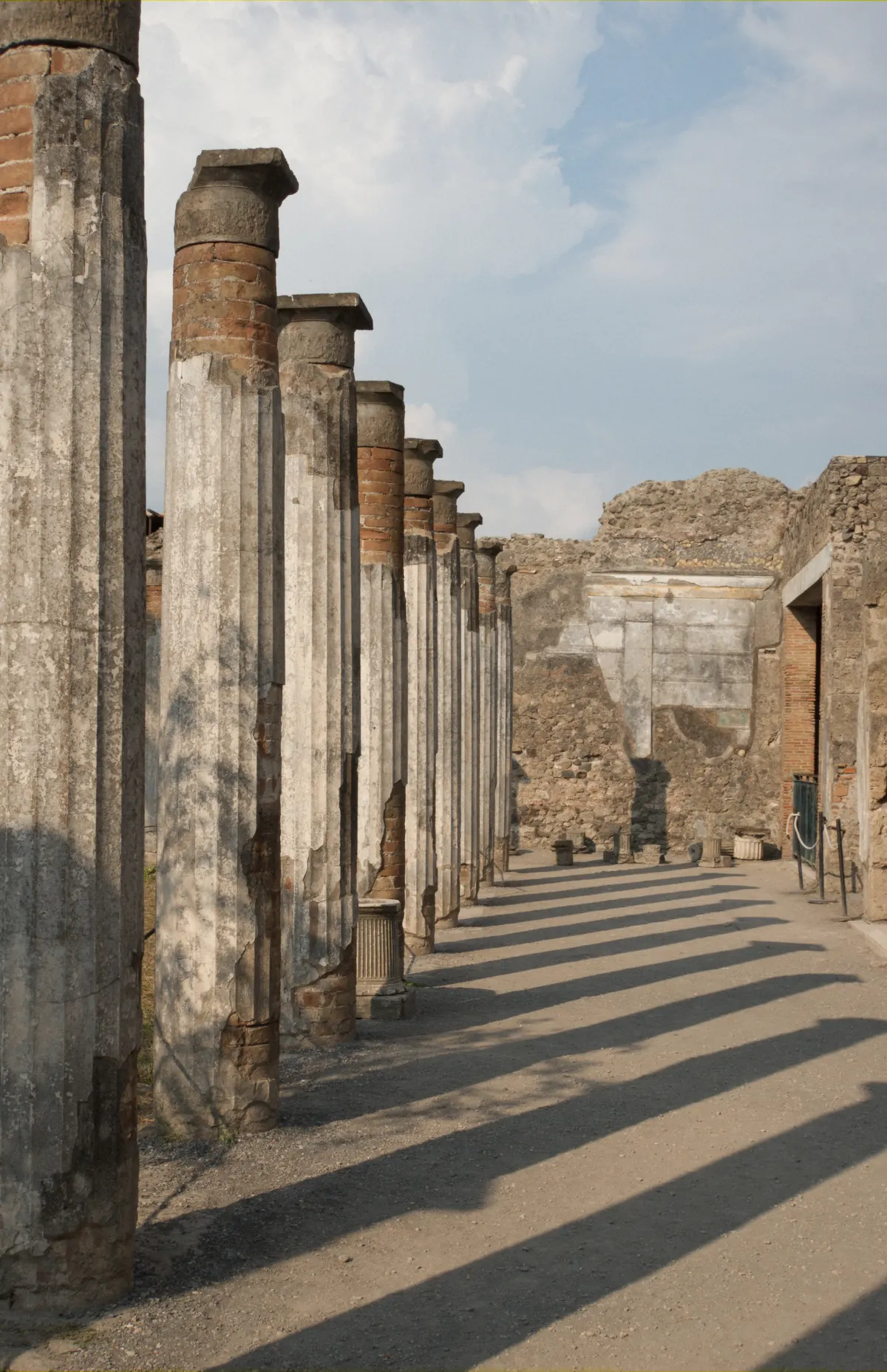
The House of the Faun’s colonnade - a full city block of it, and the Alexander Mosaic’s original floor. Photo: Jebulon / Wikimedia Commons / CC0.
The Third Hour: Theatres, Casts, Amphitheatre
The east is what separates a highlights visit from a city walk. The Large Theatre demonstrates its own acoustics to anyone who claps in the right seat; the Odeon beside it is smaller, roofed once, and usually emptier; the Quadriporticus remembers the gladiators who quartered there. South-east, the Garden of the Fugitives holds the site's largest group of plaster casts - the moment the eruption stops being scenery - and the long straight east brings the amphitheatre, older than Rome's Colosseum, its walls still carrying the painted boast of the 59 AD riot between Pompeii and Nuceria.
The three-hour listings earn their keep here; the Askos deep route is the one that names the amphitheatre outright.
The Garden of the Fugitives: the eruption’s human record, and the moment the visit goes quiet. Photo: Jamie Heath from United K / Wikimedia Commons / CC BY-SA 2.0.
The Catch: Which Houses Are Actually Open
Pompeii is a working excavation and a conservation laboratory as much as a site: houses rotate - closed for rest, study, or rain damage - and the great names are not guaranteed open on your date. The park publishes its open-buildings list (the 'open buildings' page on pompeiisites.org) and updates it; guides check it the morning of a tour, which is one of the quiet services a live guide provides that no app replicates. Practical rules: never build a Pompeii day around one house, treat the Forum zone and the streets themselves as the permanent collection, and let the open-house list of your date shape the route - it is how the guides do it.
What to See in Pompeii: Questions
How much of Pompeii has been excavated?
About two-thirds of the ancient city is excavated - roughly 44 of some 66 hectares - and visitors walk about 19 hectares of it. The unexcavated third sits under the modern town's east edge, deliberately left for future generations and better techniques.
What is the most famous house in Pompeii?
The House of the Faun - a full city block, the city's grandest private house, home of the Dancing Faun statue and the original floor of the Alexander Mosaic (the mosaic itself lives in the Naples Archaeological Museum). Check it is open on your date; rotation rules apply to everyone.
Where are the plaster casts in Pompeii?
Several spots hold casts, and the largest group is at the Garden of the Fugitives on the site's south side - thirteen victims of the pyroclastic surge, in the positions death found them. The Antiquarium museum near the Forum displays others with the eruption's story in sequence.
Can you see Mount Vesuvius from Pompeii?
Constantly - the volcano frames the Forum's north end and looms over the whole site; the connection is the visit's spine. Climbing it too (a separate park, a 30-minute crater-edge walk) makes a strong afternoon to a Pompeii morning if a car or transfer is in your plan.
What should I not miss at Pompeii if I only have one hour?
The Forum and its colonnaded frame of Vesuvius, the Basilica beside it, and one great house if the open-house list allows - that is the honest hour. It is also the argument for a private guide: one hour is exactly when sequencing matters most.
Is 2 hours enough to see Pompeii?
Enough for the western core - the twenty stops split roughly 12/8 between a two-hour and a three-hour visit. Two hours with a guide covers the Forum zone, one or two great houses, the baths and a stretch of the main street; the theatres, the casts and the amphitheatre want a third hour. The site is too big for a complete first visit in any single slot - which is why the park sells a 3-day ticket.
Is there anything to do in Pompeii besides the ruins?
Yes, in the modern towns around the fences: the Antiquarium museum inside the park reopens the eruption story in sequence, the Villa of the Mysteries (on the combined ticket) sits just outside the walls with its Roman frescoes, and the town of Pompei has the major pilgrimage basilica plus normal restaurants. Herculaneum, Vesuvius and the Sorrento coast all sit within an hour - the getting-there guide maps the rail lines that connect them.
Five Details Nearly Everyone Walks Past
Pompeii's grand monuments take care of themselves; the site's real texture sits at shin height and in doorways, and it is what a guide is actually for. The five worth hunting: the cat's eyes in the stepping stones - white stone set into the crossings so torchlight and moonlight caught them, the Roman street lighting nobody photographs; the phallic carvings and etchings on corner walls, direction markers for travellers rather than graffiti, and the reason guides earn their keep explaining Roman street culture; the ring-holes in door sills where the sliding gate bolts seated; the bread stamps in the bakery of Modestus - carbonized loaves stamped with the baker's name, an edible trademark; and the electoral notices painted on house fronts, the plain-language voice of a campaigning city ('the goldsmiths urge you to elect Gaius'). Half the value of any guided route is that someone stops you for these; the other half is knowing which doorways are original and which are 20th-century reconstruction - a distinction invisible until it is pointed out.
A note on the casts beyond the famous ones
The Garden of the Fugitives holds the largest group, but casts appear across the site - the Antiquarium keeps the sequence of how they were made, from the 1860s technique onward, and the dog cast near the… House of Orpheus tells a smaller, sharper story than the human groups. If the casts are why you came, the guide's route matters more than usual: several sit behind gates that open at the guide's request rather than on a public schedule.
The Large Theatre: 5,000 seats and acoustics that still work from the cheapest row. Photo: MumblerJamie / Wikimedia Commons / CC BY-SA 2.0.
The Open-House Rotation, Season by Season
The park's open-buildings list is not static management - it is a conservation rhythm, and it has a seasonal shape worth knowing when you plan. Summer's visitor pressure pushes restoration teams to the quieter months, so autumn and winter are when houses close for work (the Vettii's multi-year restoration ended in January 2023; others rotate through shorter closures on the same logic), while spring reopens the marquee names for the season. Practical consequences: check the official open-buildings list in the week before your visit, not the month before; hold your must-see list loosely enough to swap one house for another; and treat a closed door as a reason to book a second visit on the 3-day ticket rather than a ruined day.
Guides re-check the list every morning they work - one of the quiet, unlisted services a private route includes.
The Two-Hour Map, Drawn
Because 'what to see' resolves into a route the moment a time slot is fixed, here is the two-hour answer drawn as a line: enter at Porta Marina, take the Temple of Apollo in passing, and walk the Forum end to end with Vesuvius framed at its north end; the Basilica beside it, then north through the Forum Baths to the House of the Faun (Alexander Mosaic floor, Dancing Faun); south again past the bakery quarter to a thermopolium counter, then east two blocks of Via dell'Abbondanza to the Stabian Baths; finish at the Large Theatre, where the acoustics demo lands the visit's last wow. That line is roughly what the two-hour listings run, and a self-guided visitor can walk it from any decent map - what the map lacks is the third dimension: which houses on this line are open this month, which corridor is closed for restoration, and where the shade is at 10:40 in June. That is the working case for the guided hour even for map-confident visitors: the line is public; the line's current state is not.
And the third hour, drawn
Continue south-east from the theatres along Via dell'Abbondanza's long straight: the Garden of the Fugitives casts at the midpoint, then the amphitheatre and Palaestra at the city's east end - the oldest surviving Roman amphitheatre and the walk's structural finish. The return to Porta Marina is 25 minutes on foot; the three-hour listings that include this leg end at the east gate or budget the walk-back inside the third hour.
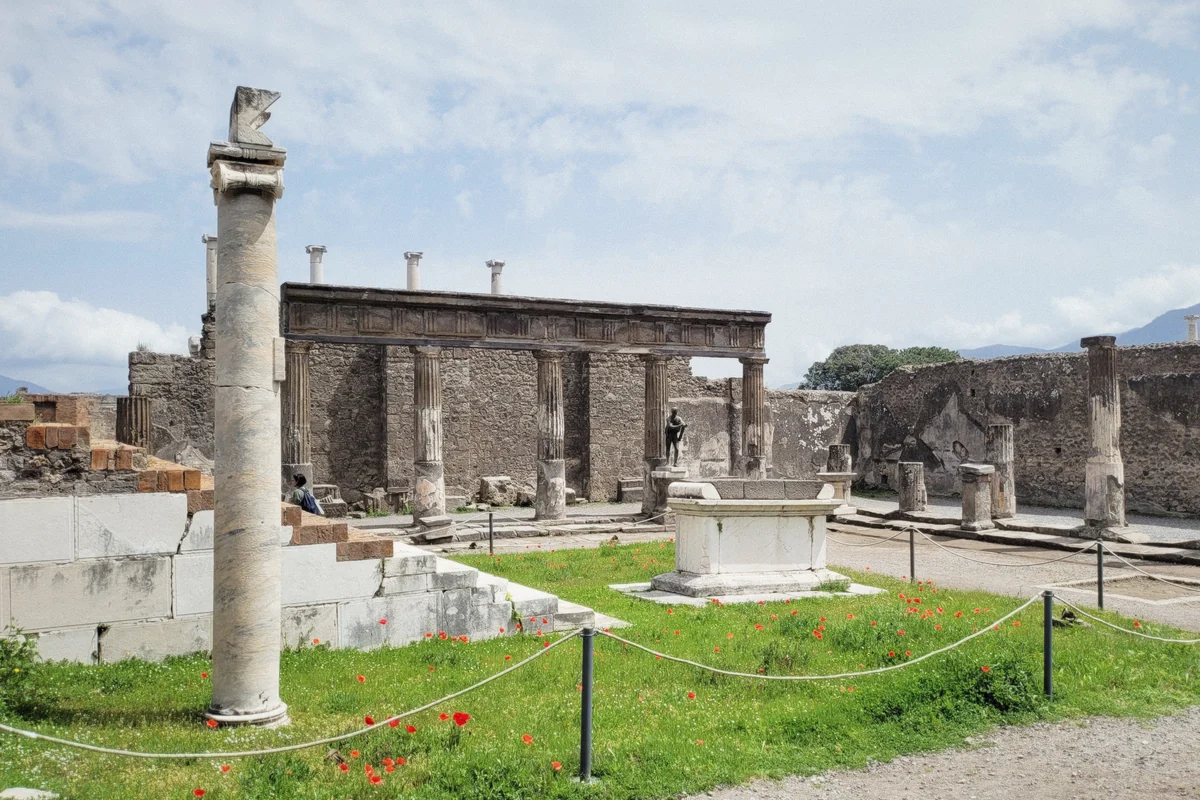
The Temple of Apollo’s columns: older than the Roman city around them, and the first stop past Porta Marina. Photo: Bernard Gagnon / Wikimedia Commons / CC BY 4.0.